Operating Software for Painting Contractors

You still run the company.
PaintCurrent eliminates what came after.

Hours get entered. Payroll gets processed. Expenses get recorded. PaintCurrent eliminates the work you used to do after those things — just to find out where the company stood. Beyond the project level, most contractors don't know the truth until year-end.

Current visibility. No extra work.
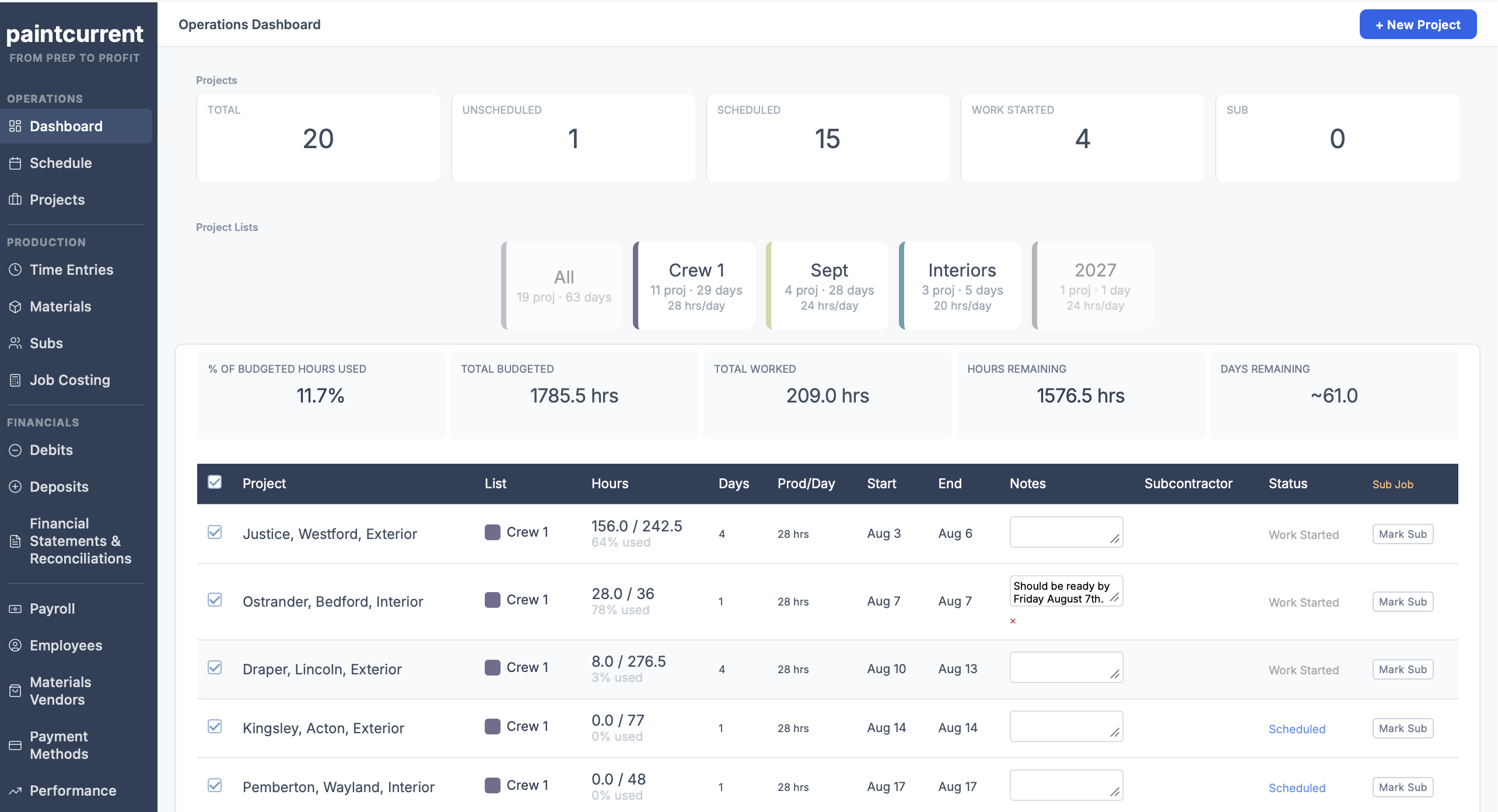
PaintCurrent operations dashboard — projects, scheduled work, production hours and company KPIs

Less gathering, copying and recalculating

Enter or connect the information once. The system keeps the calculations current.

Current, not reconstructed

The operating picture stays together as the company runs — not rebuilt every time you need an answer.

Phone · tablet · desktop

Open it from the field, the office, or anywhere the question comes up.

Keep the tools that work

CRM, estimating, payroll and accounting can stay. PaintCurrent works around them.

Use PaintCurrent Your Way

Three ways to use PaintCurrent.

Option 1

Use it by itself.

Enter projects, estimated hours, actual hours, materials, subcontractors, payroll and expenses directly. No other system required.

Option 2

Pair it with a CRM or estimating system.

Keep PaintScout, Estimate Rocket, or whatever you already use for leads and estimates. Accepted jobs move into PaintCurrent for the operating side.

Production-rate estimating establishes what should happen. PaintCurrent follows what actually happens.

Option 3

Connect the systems you already use.

Already have payroll and accounting you like? Keep them. PaintCurrent connects to or receives information from those systems — one operating picture, immediate access to current reporting.

Enter the information once, keep it connected, and know where the company stands.

Immediate Answers

Open your phone and know
where the business stands.

Instead of gathering information every time you need an answer, the numbers are already there.

How much work do we have?

Projects, production hours, and working days booked. How much each crew has ahead. Whether you need more work — or are already further out than you realized.

What's happening with the schedule?

Built around actual crew productivity. Change a start date, hours per day, or project order — the schedule recalculates.

How are the jobs doing?

Budgeted hours against actual. Labor, materials, revenue, collections, balances, and current project performance — without rebuilding the job after it's over.

What is the company actually making?

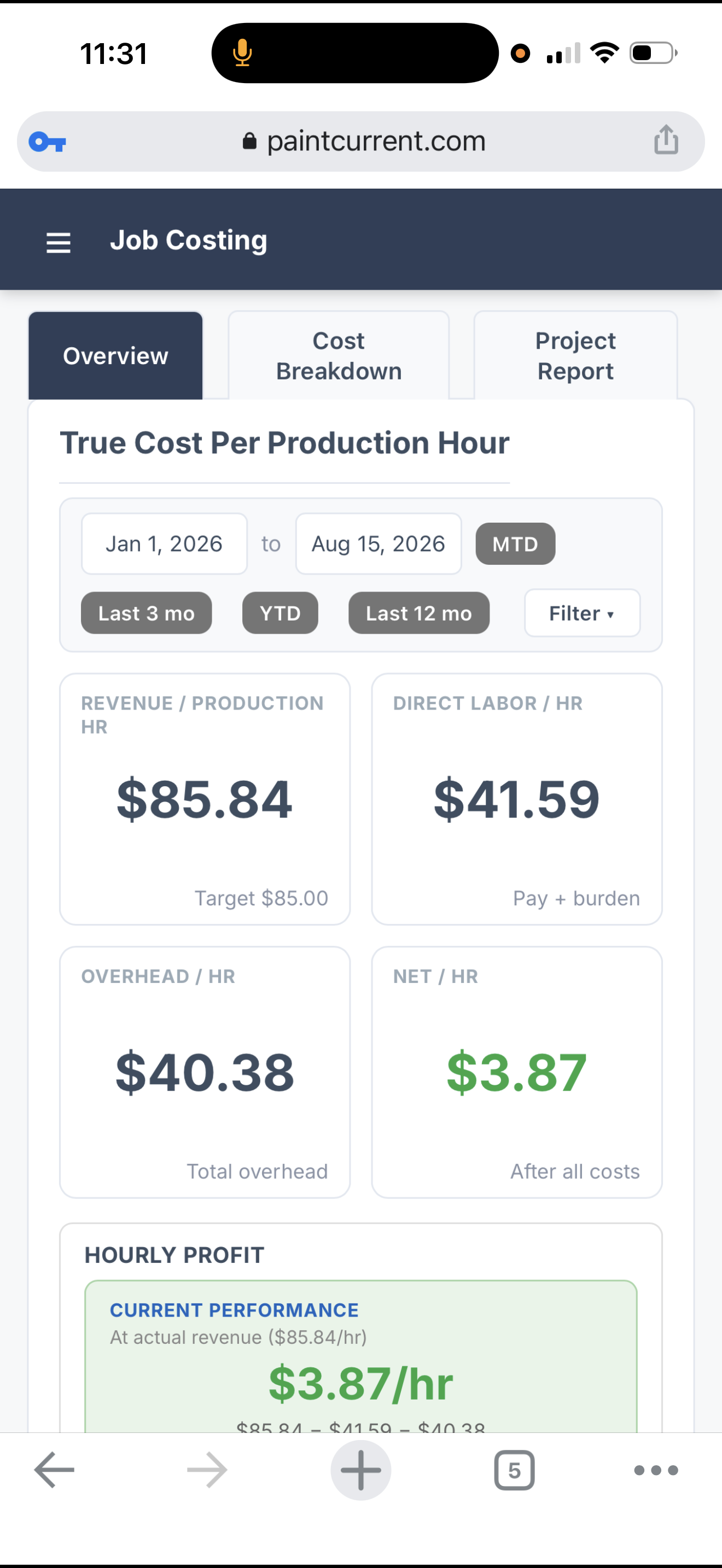
Revenue per production hour, actual labor cost, true overhead, job profitability, and net profit per production hour.

Already Estimate With Production Rates?

Don't stop measuring production when the estimate is accepted.

Your estimate tells you how many production hours the job should take. PaintCurrent keeps following those hours after the estimate is accepted.

Estimated Production Hours Actual Production Hours Revenue per Production Hour Actual Labor & Materials Job Margin
The Two Numbers I Could Not Find
True Overhead per Production Hour
What every production hour actually has to carry.
Net Profit per Production Hour
What the whole company actually keeps per production hour.

Production rate estimating tells you what should happen. PaintCurrent follows the same production hours all the way to what the company actually made.

From the Founder

This was taking me too much time. I built something that fixed it.

CRM helped. Estimating software helped. Payroll helped. Accounting helped.

But every system solved its own piece. Production hours were in one place. Payroll was somewhere else. Materials, expenses, receivables and bank activity were somewhere else again.

The numbers were scattered across bank accounts, credit cards, the accountant or payroll service, and whatever tools were in use. And if you actually wanted to get to the bottom of things — there were always going to be a few spreadsheets. Keeping up with the business was becoming a job of its own.

The dream was not complicated: enter or import the information once, keep it connected, and stop rebuilding the picture from scratch every time you needed an answer.

I don't have a single spreadsheet anymore that contains financial or operational data.

— The Founder
The Real Operating Workflow

Here is exactly how I use PaintCurrent.

PaintCurrent is not something I open once a month to create a report. It is the operating layer I use throughout the week.

Dashboard

How many hours and days of work are booked, how much each crew has ahead, and what is outstanding.

See how it works
Open the dashboard and see total booked production hours, working days per crew, collections vs. outstanding, and whether you need more work — or are already further booked than you realized. No spreadsheet. No calls. It is already there.PaintCurrent operations dashboard
Scheduling

Crew productivity drives the schedule — reorder jobs and the dates recalculate around it.

See how it works
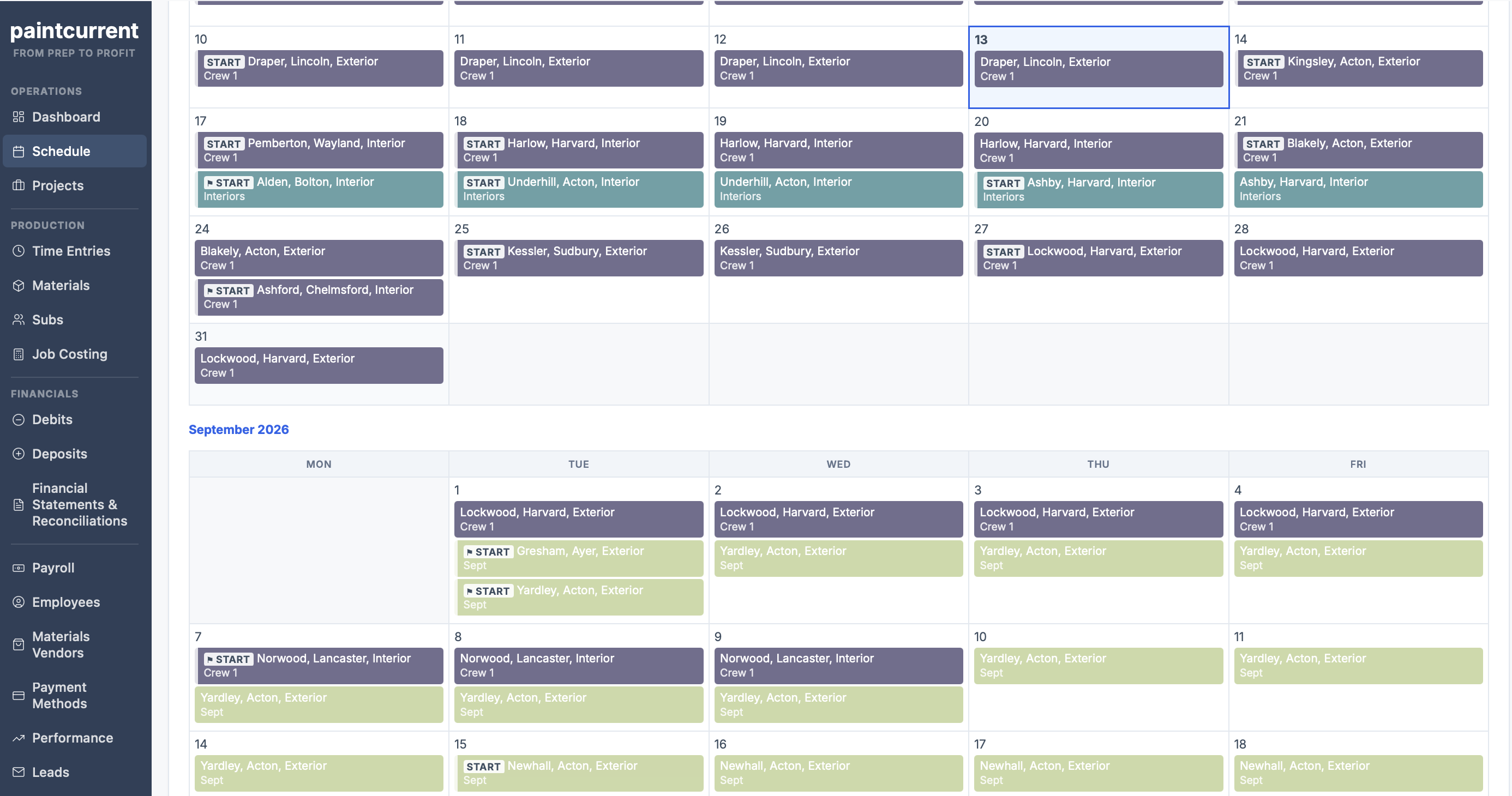
Each crew's productivity rate determines how many days a job takes. Drag to reorder and every start date downstream recalculates. Override a start date, hours per day, project duration, or buffers when reality requires it. The schedule stays tied to actual production capacity.PaintCurrent scheduling view
Projects

Receivables, balances, and performance for every project moving through production.

See how it works
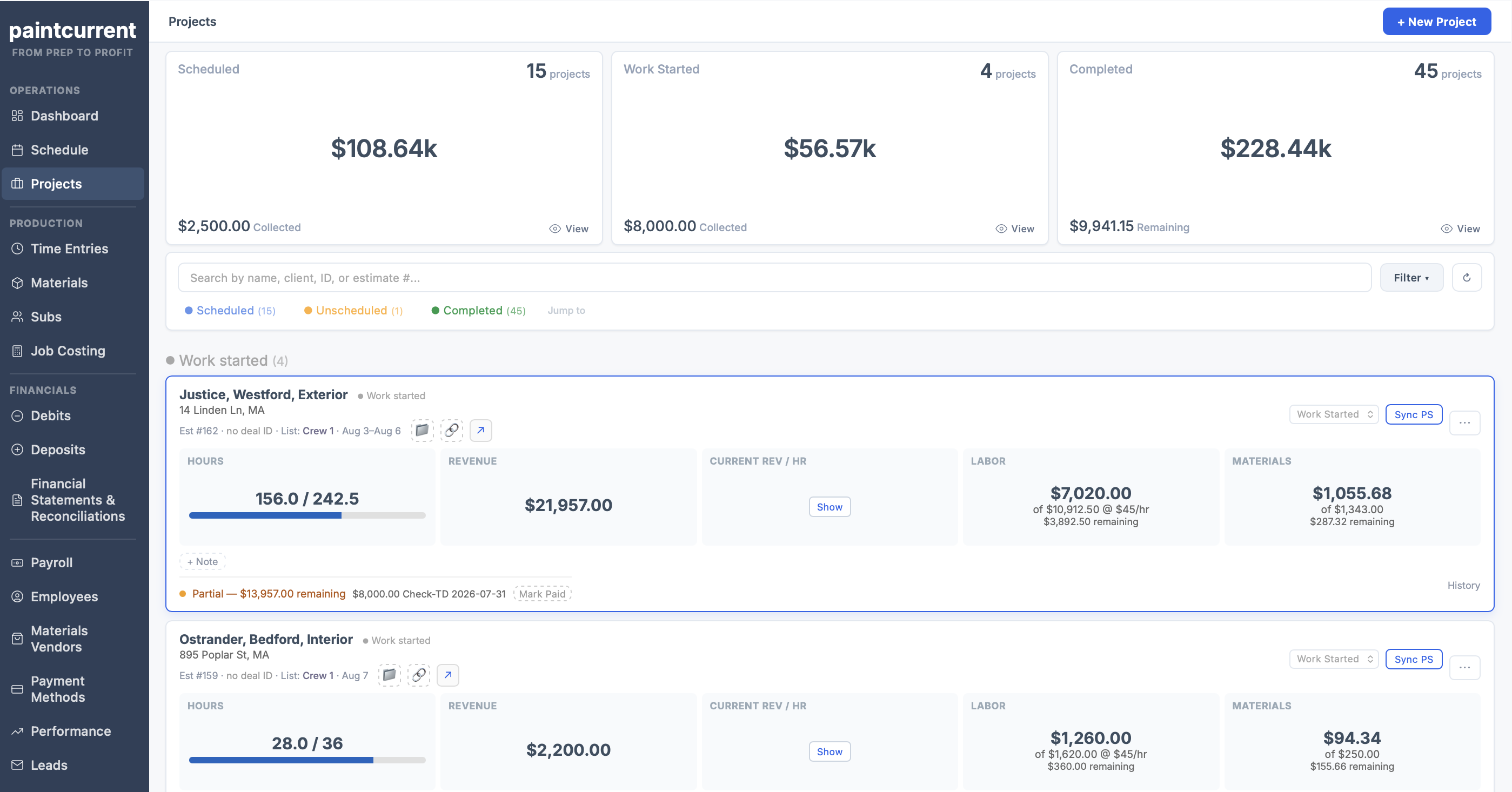
For every active job: revenue, amount collected, balance outstanding, budgeted hours, actual hours to date, materials, subcontractor costs, and current performance. For completed jobs: final margin, total hours, collections, and profitability — without rebuilding the job after it closes.PaintCurrent projects view
Job Costing

Hours, labor, burden, materials, subs, revenue, and margin — with the calculations visible so you understand why, not just what.

See how it works
Production hours, payroll wages, employer burden, materials, subcontractor costs, revenue per production hour, job margin, and overhead allocation — with every calculation shown. The goal is not to tell you a job made 28%. It is to let you understand why, so you know which number to change next time.PaintCurrent job costing view
Payroll

Process and reconcile payroll as part of the operating system — not maintained separately from everything else.

See how it works
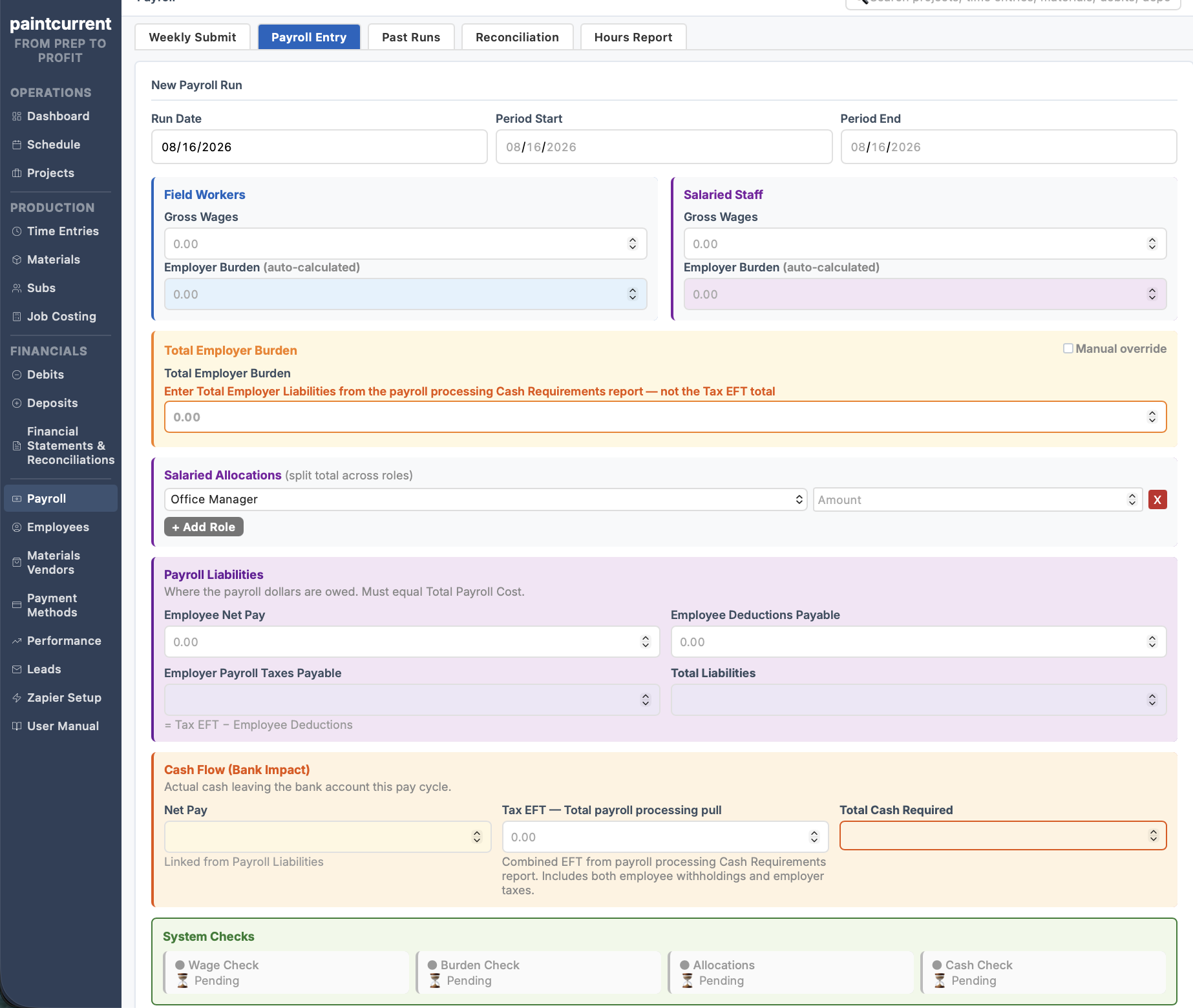
Enter payroll runs and reconcile them against the bank. Separate production hours from non-production hours. Capture employer burden — SS, Medicare, and other employer taxes — not just the wage. The reconciled payroll data flows directly into job costing and company profitability, so those numbers are real, not estimated.PaintCurrent payroll entry view
Financials

Bank and card activity connected to the operating picture so nothing quietly falls through the cracks.

See how it works
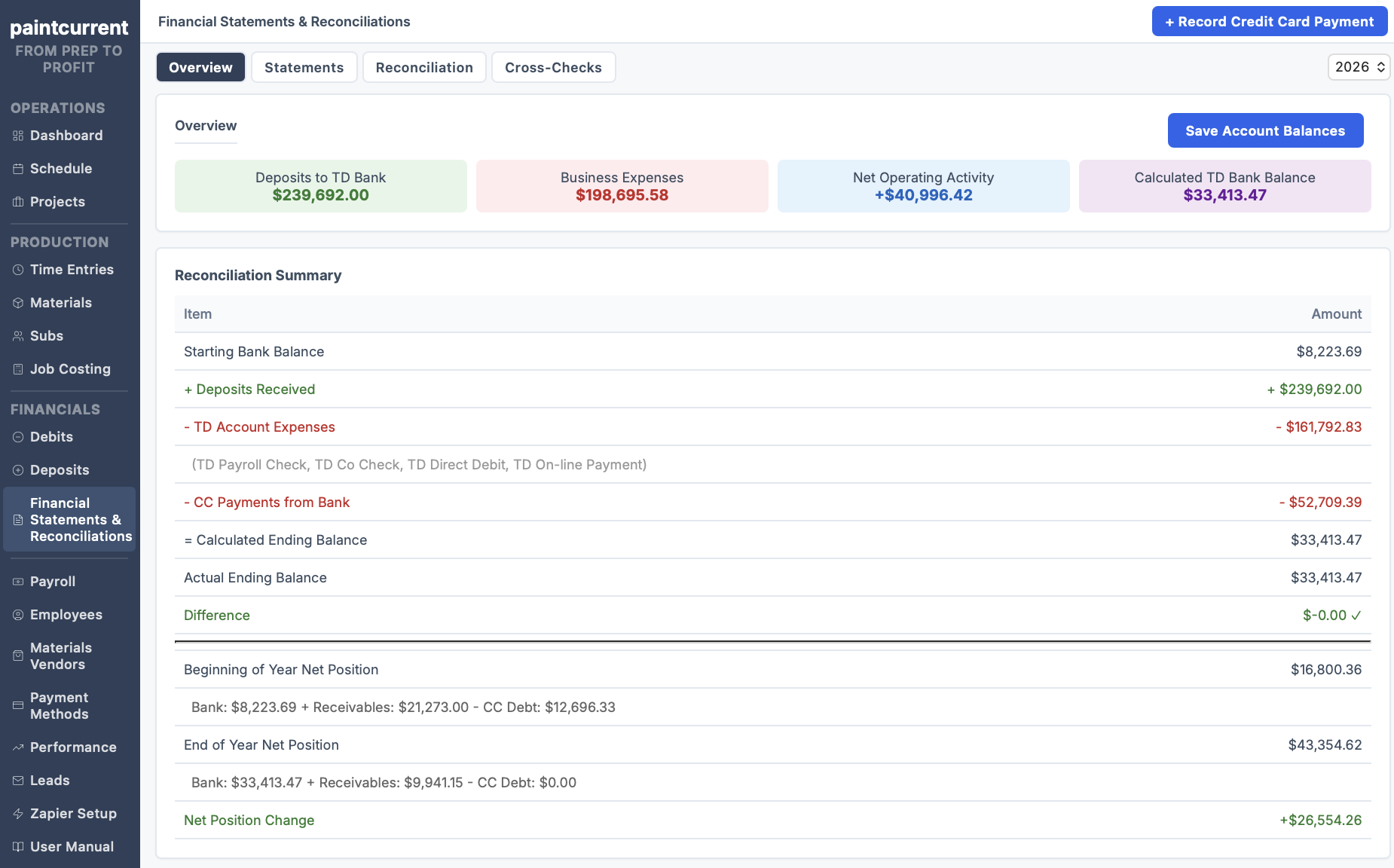
Track every way money leaves the business and every deposit coming in. Reconcile bank and card activity against operating records. Flag exactly where costs do not yet agree with records. Financial statements update as transactions are entered — current performance, not a year-end summary.PaintCurrent financials and reconciliation view

I still run the company. Hours still get entered. Payroll still gets processed. Expenses still get recorded. PaintCurrent eliminates the work I used to do after those things just to find out where the company stood.

The Operating Rhythm

A small routine keeps the picture current.

Because the operating information is maintained as the business runs, you don't have to start over every time you want to know how the company is doing.

During the week
Run production.
Projects, hours, materials, progress and schedule changes happen as the work happens. Run the company. PaintCurrent keeps up.
Weekly
Payroll + bank.
Process and reconcile payroll, capture actual labor and burden, and reconcile primary bank activity.
Monthly
Cards + remaining expenses.
Finish credit cards, creditors and remaining operating expenses. The period is essentially current and complete.

A fraction of the work. Complete current visibility.

A Claim Worth Making

We looked at Jobber, Knowify, ServiceTitan, Housecall Pro, Workiz, Buildertrend, Painter's Log, PaintLogic, and others.

What we did not find was a system built to keep this number current:

Net Profit per Production Hour

Based on actual production hours, actual payroll, and current operating costs.

As hours, payroll, bank activity, and expenses are reconciled, the number updates with them. Running the company becomes the reporting.

No chasing the numbers. Just a current answer to:

What is the company actually making per production hour?

Not one job. Not an average of job margins. The whole company — after direct job costs and operating overhead are accounted for.

What the Connected Workflow Gives You

Three questions answered without rebuilding the numbers.

Question 1
Are the crews producing?
Budgeted vs. actual production hours, capacity, and productive vs. non-productive time — tracked continuously, not reconstructed at the end of the week.
Production Efficiency
Question 2
Did the jobs make money?
Revenue against actual direct labor, burden, materials, subcontractors, and direct costs. The job's contribution — before company overhead clouds the picture.
Job Margin
Question 3
Are the jobs carrying the company?
Bring in salaries, non-productive labor and operating overhead. See what production leaves behind after carrying both the work and the entire company.
Net Profit per Production Hour

Questions owners ask

Does it replace my estimating or CRM software?
Not necessarily. PaintCurrent is designed to take over primarily after the job is accepted. Your existing estimating or CRM system — like PaintScout or Estimate Rocket — can continue handling leads, estimates and sales while accepted jobs flow into the operating system.
Is my company too small for this?
If you're still personally responsible for selling work, scheduling production, managing crews, payroll, job performance and keeping an eye on the company's finances, this was built for that stage of business. The question isn't how big your company is. It's how many responsibilities still land on you.

Use what works. Do less work. Know the numbers.

Spend less time gathering numbers. Spend less time calculating. Spend less time wondering whether the information is current.

Save time. Know the numbers. Run the company.

We'll start with how you run the company today — not with asking you to replace it.

Articles